
Veteran Pathway
From Military to Executive Protection
Executive protection is one of the cleanest career transitions for veterans with infantry, special operations, MP, or security cooperation backgrounds. Here is what the work actually looks like.
At a Glance
Executive protection is a strong career pathway for transitioning military personnel, particularly those from infantry, special operations, military police, security cooperation, and personal security detail backgrounds. The discipline rewards the soft skills, planning rigor, and operational discipline that the military trains, and many of the hard skills transfer directly. Praetorian Executive Protection's founder, Christopher Smith, served as a Gunnery Sergeant (E-7) in the United States Marine Corps from 1999 to 2012 and built the firm specifically to bring veterans into real protection work.
Selection Is Provisional
Selection for this pathway does not make a candidate a full Praetorian operator. Operator status is earned only after completing the full vetting process, required Florida licensing, academy training evolutions, and a signed agreement.
If you served in a unit that did force protection, PSD work, MP duties, advance work, or any kind of personal security assignment, you already have most of the skills executive protection requires. What is missing is the civilian operating environment and the protocol for working with HNW principals instead of military personnel.
That gap is closeable. This page is the honest version of how to close it.
Skills Transfer
Soft skills, planning discipline, situational awareness, and weapons handling all transfer directly. The mindset is the hardest thing to teach and you already have it.
Realistic Pathway
Most veterans need a Florida Class D / Class G license, an EP-specific course, and a willingness to start as part of a detail under a senior operator.
Founded by a Marine
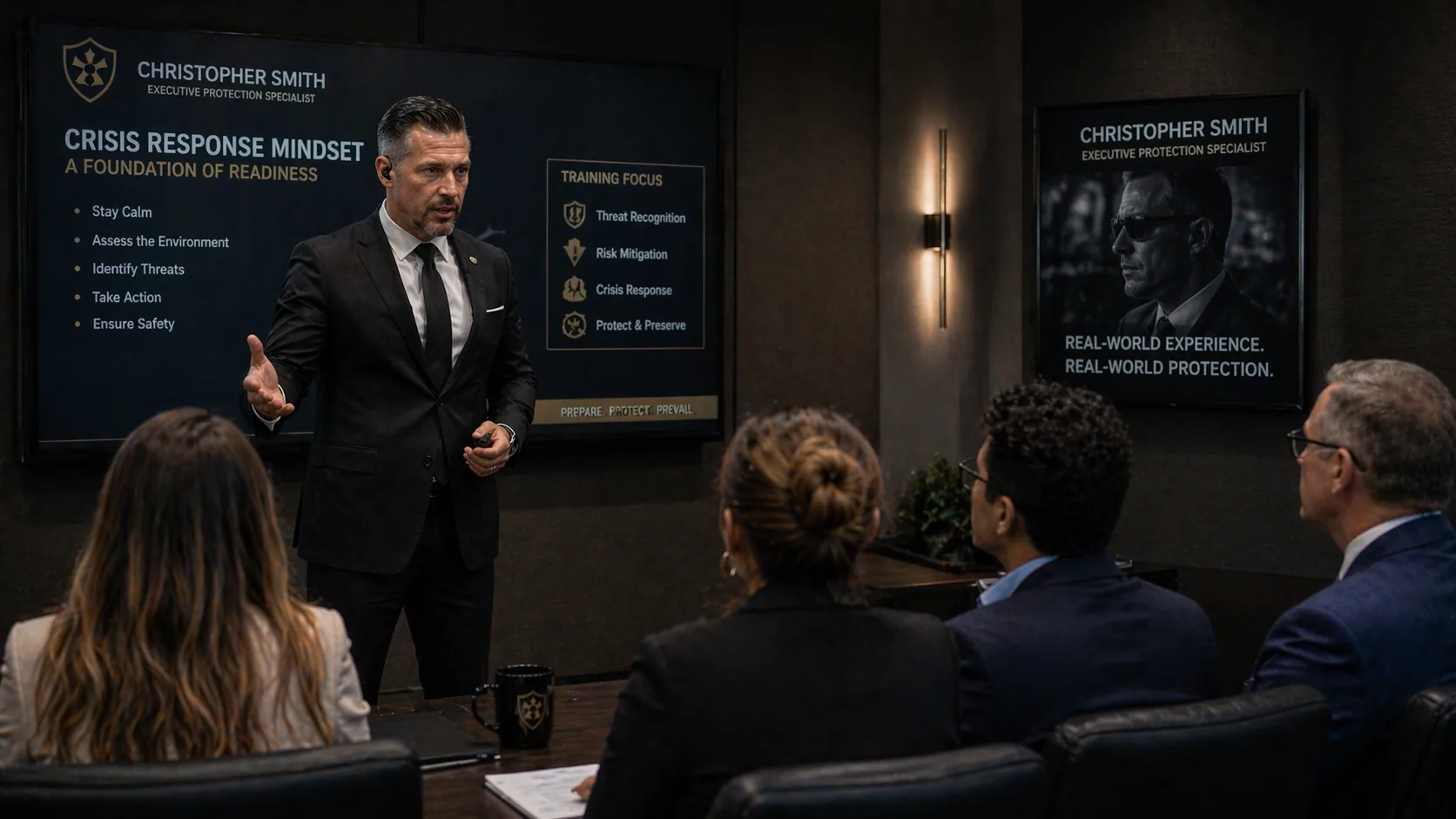
Christopher Smith served as a Gunnery Sergeant (E-7) in the United States Marine Corps from 1999 to 2012 with infantry and combat instructor roles. He built Praetorian for veterans like you.
No Recruiter Fluff
EP is not the action movie. Most of the work is planning, advance, observation, and soft-skill execution. If that is the work you want, this is the right field.
Why the Military-to-EP Transition Works
The skills that make a good EP operator are the skills the military trains for. Situational awareness, weapons proficiency, trauma care, communication discipline, planning under pressure, and the ability to work as part of a small team are all foundational.
Civilian executive protection adds soft skills, principal etiquette, low-profile presentation, and legal context. None of that is hard to learn for someone who already has the operational base.
Where Veterans Get Stuck
The most common failure point in the transition is presentation. EP is not the military.
Visible kit, tactical aesthetic, and command presence work against you in this field. The job is to be invisible to everyone except the principal, to dress like a corporate professional, and to handle conversations with high-net-worth clients and their staff with the same competence you brought to a patrol brief.
Veterans who can adjust their presentation succeed. Veterans who cannot, do not.
How Praetorian Brings Veterans In
We hire transitioning veterans as W-2 employees of our Class B Security Agency, initially on scheduled assignments under the direct supervision of senior operators. The first shifts are scoped so that the new operator can demonstrate capability without being responsible for the entire detail.
Performance moves an operator into more consistent scheduling and eventually into recurring residential or family detail work. The pathway is real and it is open to candidates who do the work.
What We Look For
- Honorable discharge, verifiable service record
- Infantry, special operations, MP, security cooperation, or PSD background
- Florida Class D / Class G license (or willingness to obtain)
- Clean civilian background since separation
- Discretion and OPSEC discipline
- Willingness to dress and present as a corporate professional
- Geographic flexibility for assignments across Florida
What Praetorian Provides
- W-2 employment with a Florida Class B Security Agency (License B3600136)
- Hourly wage with FLSA overtime, paid through standard payroll
- Workers' compensation and general liability during assigned duties
- Duty equipment and uniforms issued by the agency
- Mentorship from a 30+ year practitioner who started in the USMC
- Real EP assignments under senior operator supervision
- Pathway to recurring and long-term post work for operators who perform
Frequently Asked
Questions About This Role
What military backgrounds transfer best to executive protection?
Infantry, special operations, military police, security cooperation, and any prior personal security detail (PSD) experience transfer directly. Combat arms backgrounds bring weapons and trauma proficiency. PSD backgrounds bring the actual EP framework already.
Do I need an EP-specific course before applying?
Not always. Strong military backgrounds with the right soft skills can be considered without a formal EP course, with the expectation that the operator will train into the role. Where a course is required, we discuss it during the consultation.
Is Praetorian's founder actually a veteran?
Yes. Christopher Smith served as a Gunnery Sergeant (E-7) in the United States Marine Corps from 1999 to 2012, with infantry and combat instructor roles. He went on to law enforcement, federal task force operations, and corporate executive protection. The pathway he asks veterans to follow is one he walked himself.
Will I be expected to look tactical?
No. Tactical aesthetic is the opposite of what EP requires. Operators dress in business attire, blend into corporate and high-end environments, and stay invisible until the moment they need to act.
How do I apply?
Submit the application form on the careers page. Note your service record, MOS, and any PSD or security-related assignments. Discretion is mutual. We do not contact your current employer without permission.
Engagement: W-2 Employment
This position is a W-2 employment role with Praetorian Executive Protection LLC. The role is subject to standard payroll withholdings and company-provided insurance coverage. This classification is required under Fla. Stat. § 493.6301(4), which provides that a Class D licensee shall own or be an employee of a Class B security agency.
- Active Florida Class D license, and Class G for armed assignments, or willingness to obtain
- Standard payroll withholdings (federal income tax, FICA, Medicare)
- Company-provided workers' compensation and general liability coverage during assigned duties
- Duty equipment and required credentials issued or authorized by the agency
- I-9 verification, background check, and FDACS fingerprinting as required by Chapter 493
- Reported to the Florida State Directory of New Hires within 20 days of hire
Praetorian utilizes a hybrid staffing model. Detailed classification is confirmed at the time of offer. See the full engagement standards on the Careers page.
Other Operative Pathways
Browse the full operative role index for every career path Praetorian recruits across.
Florida Operative Recruitment
Executive Protection Jobs in Florida
Praetorian recruits experienced operators across Brevard County, Orlando, Miami, Tampa, and Jacksonville. Real EP work with real principals, not contract guard shifts.
Lioness Program Recruitment
Female Executive Protection Specialist
Praetorian's Lioness Program staffs female protection specialists for female principals, family details, and assignments where gender access matters. We are actively hiring.
Career Pathway
Becoming a Praetorian Operative
If you want to do real executive protection work for serious principals, this is the pathway. Honest expectations, clear requirements, and direct mentorship.
Compensation
Operative Compensation and Benefits
W-2 employment with a Florida Class B Security Agency. Competitive hourly wages, FLSA-compliant overtime, workers' compensation coverage, and a real career pathway for operators who perform.
Event and Travel Security
Event and Travel Security Specialist
Praetorian is hiring operators for event security planning, venue advance work, and domestic and international travel security details for HNW clients and corporate principals.
Residential and Family Protection
Residential and Family Protection Specialist
Praetorian is hiring operators for long-term residential security, family protection details, and home security assessments for HNW families across Florida.
Clandestine Operations
Clandestine Operations Specialist
Praetorian is recruiting experienced operators for low-visibility protection, surveillance detection, and counter-surveillance operations requiring the highest level of discretion.
Crisis Management
Crisis Management and Emergency Response Specialist
Praetorian is recruiting operators with crisis response, extraction planning, and emergency management backgrounds for high-stakes engagements where the margin for error is zero.
Maritime Security
Maritime and Yacht Security Operator
Praetorian is hiring operators for vessel protection, port security, and marina operations across Florida's waterways and the South Florida yacht market.
Security Consulting
Security Consultant and Vulnerability Auditor
Praetorian is hiring consultants and auditors for facility assessments, vulnerability audits, and security program reviews for corporate, residential, and institutional clients.
Security Training
Executive Security Awareness Trainer
Praetorian is hiring trainers to deliver security awareness programs for corporate executives, HNW families, and organizational staff across Florida.
Secure Transportation
Secure Transportation and Motorcade Operator
Praetorian is hiring operators for defensive driving, route planning, armored vehicle operations, and multi-vehicle motorcade execution for HNW principals across Florida.
Digital Threat Protection
Digital Threat Protection and Cyber OPSEC Analyst
Praetorian is hiring analysts for data broker removal, social media threat monitoring, doxxing prevention, and digital footprint management for HNW principals.
Hurricane Response
Hurricane Protection and Evacuation Specialist
Praetorian is building a bench of operators trained for pre-storm planning, secure evacuation, stand-behind residential coverage, and post-storm overwatch across Florida.
Cruise Security
Executive Cruise Protection Operator
Praetorian is hiring operators for close protection aboard commercial cruise sailings and private charters out of Florida ports. Onboard details, shore excursion coverage, and port embarkation security.
Ready to Apply?
Military to Executive Protection
Submit your credentials. New operators are onboarded year-round as engagements come online. Classification is confirmed in writing at the time of offer.
Get Started
Every Engagement Begins with a Confidential Consultation
Get a professional 30-minute security assessment with a senior practitioner, not a salesperson.
Available 24/7. No questions asked. Secure results.
Request Your Security AssessmentWondering about rates first? See what executive protection costs in Florida.