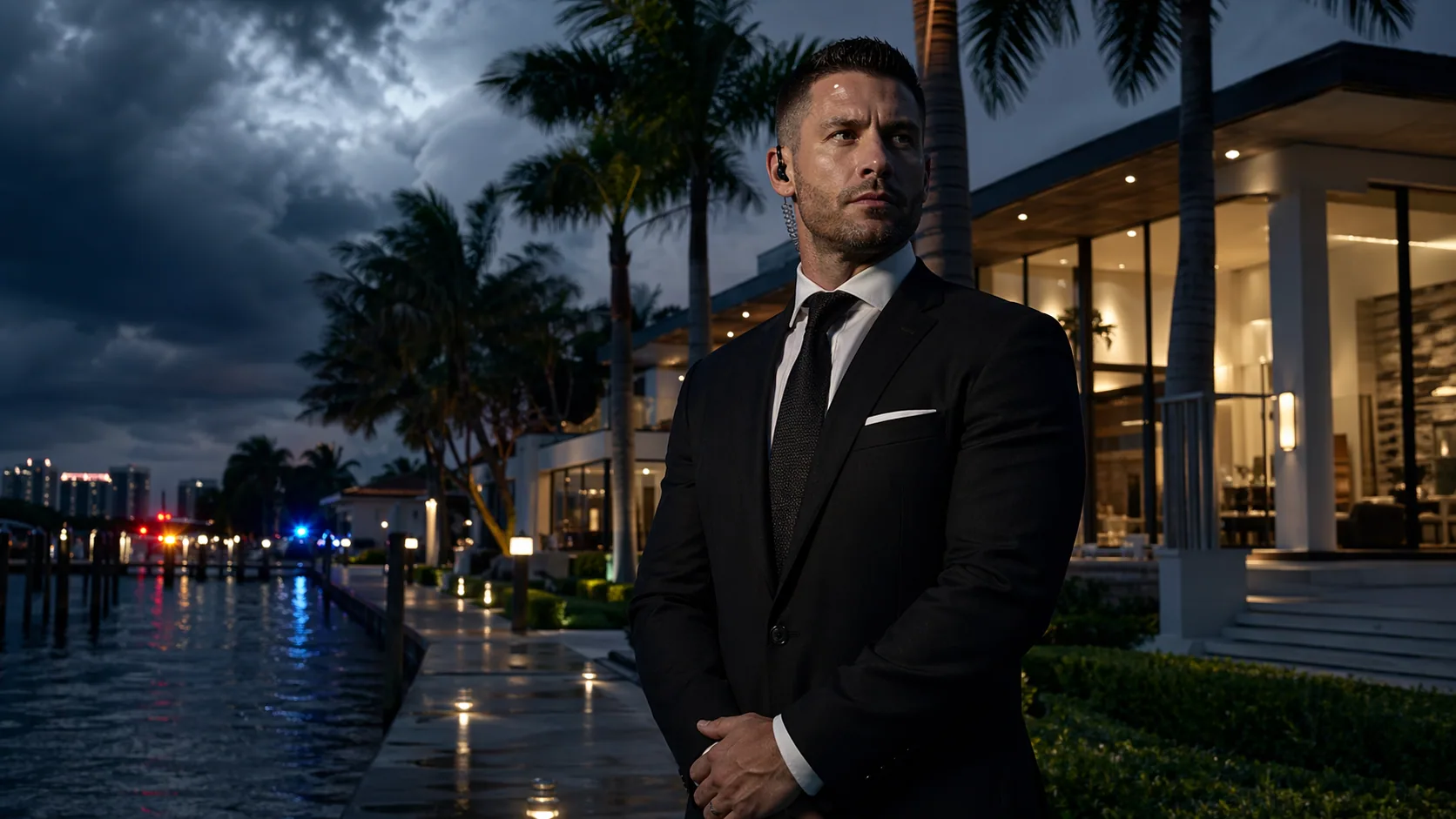
- Becoming an executive protection agent in Florida requires a Class D Security Officer License, typically a Class G firearms license, and real security experience.
- Realistic career progression takes 1-3 years of verifiable experience under a licensed Class B agency.
- Military or law enforcement background is common but not required.
- Praetorian prioritizes disciplined operators with strong planning, discretion, and judgment skills.
Table of Contents
Becoming an executive protection agent in Florida requires a Class D Security Officer License (40 hours), typically a Class G firearms license (28 hours), and real security experience. The security industry values both formal education and practical experience, and specialized academies offer training for those entering the executive protection industry. Skip the certificate mills. Work under a licensed Class B agency, build a verifiable track record, and earn your way onto serious details over 1 to 3 years.
This guide comes from Praetorian Executive Protection LLC, based in Cocoa, Florida. Founder Christopher Smith brings 30 years of experience across USMC combat operations (1999 to 2012), state law enforcement including DEA T3 task force work, and corporate executive protection culminating in site security lead for Jeff Bezos and the Amazon Board at Kennedy Space Center. His military training provided foundational skills essential for a successful career in executive protection.
The steps outlined here are the steps Praetorian operators actually follow. Realistic timelines, licensing requirements, training choices, pay expectations, and red flags to avoid. Consider your future in the executive protection industry and the importance of ongoing education to advance your career.
What does an executive protection agent really do?
Executive protection centers on advance-planned security for high-net-worth individuals, corporate executives, families, and public figures. Agents are responsible for protecting the life of the person (client) from potential threats in various environments. This differs fundamentally from basic guard work. The job is heavily focused on logistics and planning rather than immediate combat.

Concrete tasks include advance work at venues, secure transportation coordination, residential coverage, event security, and low-visibility movement across locations like Orlando, Miami, and the Space Coast. Advance work involves identifying and mitigating potential threats to ensure the safety of the person being protected. Agents must blend into corporate and family environments, operating in boardrooms, private hangars, resorts, and residences.
At Praetorian, protecting clients' lives requires adapting to different environments and understanding the unique needs of each person. Work includes executive protection services for corporate leaders, family offices, and private clients who expect discretion and professionalism rather than bodyguard theatrics.
Do you need military or law enforcement experience to work in executive protection?
Military or law enforcement experience is not required. However, approximately 75% of current Close Protection Officers come from military or emergency services backgrounds, indicating a strong preference in the field. The strongest candidates often come from USMC, Army, federal law enforcement, SWAT, DEA task forces, or special forces units, whose advanced military training and operational expertise are highly valued.
Military training, especially from special forces backgrounds, is essential for working in hostile environments like conflict zones, where private security companies typically require a minimum of four years of service and multiple hostile tours. While military experience is advantageous, it is not a strict requirement; expertise can also be developed through quality training and the right professional attitude.
Christopher Smith’s path demonstrates valued backgrounds: USMC combat operations (1999 to 2012), state law enforcement including DEA T3 task force operations, then corporate EP leading site security for Jeff Bezos and Amazon’s Board at Kennedy Space Center. Learn more about our founder.
What employers value versus what just looks good:
-
Valued: USMC infantry, Army combat deployments, federal task force work, SWAT operations, special forces experience, and demonstrated expertise
-
Less valued: Administrative military roles, “military-style” marketing with no field experience
Both veterans and civilians can achieve expertise in executive protection through rigorous training, strong medical skills, local Florida security experience, and work with reputable agencies building verifiable records.
What executive protection skills and mindset do employers actually look for?
Becoming an executive protection agent requires specialized training, previous security or law enforcement experience, and high-level interpersonal skills. Employers prioritize soft skills like discretion and communication because agents spend most time on client comfort and productivity. Sound judgment, knowledge, and calm under pressure rank higher than tactical theatrics.
Core Skills Employers Seek
Advance Planning
Route selection, venue reconnaissance, and threat mitigation before movement.
Situational Awareness
Constant scanning for pre-incident indicators and environmental changes.
Discretion and Judgment
Blending into corporate environments while making sound risk decisions.
Client-Focused Service
Prioritizing principal comfort and productivity alongside security.
Core skills employers seek:
-
Advance planning and route planning for secure movements
-
Situational awareness involving constantly scanning for pre-incident indicators to detect potential danger
-
Defensive tactics for managing aggressive situations and protecting clients from potential threats
-
Firearms proficiency and safe handling under stress
-
First aid skills including CPR and wound care for emergency response
-
Technical proficiency in modern security hardware, GPS tracking, and cybersecurity
-
Interpersonal skills for client-focused service and relationship management
-
Decision making skills for effective risk assessment, threat management, and operational planning
Effective communication skills are crucial for building trust with clients and managing relationships during high-pressure situations. Agents need sound judgment, strong knowledge of security concepts, and comfort around C-suite executives, as well as the ability to operate in luxury environments without drawing attention.
Praetorian favors candidates who integrate with corporate security teams, HR, and risk management staff. Our detail leaders have operated at Kennedy Space Center and high-visibility Florida events, delivering protective intelligence requiring both tact and discipline.
A successful executive protection specialist must master both tactical and interpersonal skills, including discretion and professionalism.
How do Florida Class D and Class G licenses work for executive protection?
In Florida, almost every executive protection agent starts with a Class D Security Officer License. Most serious operators add the Class G statewide firearms license. A high school diploma or GED is the minimum requirement, though criminal justice degrees may be preferred.
Class D Process: The 40-hour state-mandated course covers legal authority, patrol techniques, and emergency procedures through a licensed training provider. Following fingerprinting through FDACS and application submission (fees approximately $50 to $100), expect 2 to 4 weeks processing time.
Class G Process: The 28-hour firearms course includes range qualification, safe handling, Florida use-of-force law, and psychological fitness requirements. If the role is armed, agents must obtain state-specific concealed carry permits and meet armed guard requirements.
Florida requires armed EP work under a licensed agency with proper insurance and a Class B license. Praetorian operates under Florida Class B License B3600136.
Realistic Timeline:
-
Days 1 to 5: Class D course and exam
-
Week 2: Fingerprints and application
-
Week 4: Class D license in hand
-
Weeks 5 to 7: Class G course and qualification
-
Week 10: Armed license complete
How should you choose executive protection training that actually matters?
Many programs sell certificates, not competence. Hiring managers know which academies and companies produce field-ready security professionals. Reputable academies and companies offer comprehensive bodyguard training and executive security programs, often taught by instructors with real world experience in personal protection. Educational qualifications typically include completing accredited EP programs, such as the Certified Executive Security Specialist course or training at the Executive Protection Institute—credentials that are highly respected in the industry and valued by employers seeking qualified graduates.
Executive protection training programs should include classroom instruction and hands-on practical exercises to prepare students for real-world scenarios. Essential course components include defensive driving, firearms training, and defensive tactics, ensuring that security professionals are equipped with industry standard skills. Look for accreditation, field exercises, scenario-based evaluations, advance work on real venues, and live-fire training with honest grading. Many programs emphasize defensive tactics, threat assessment, and risk management as core curriculum components. The length of executive protection training courses varies significantly, from a few days to several weeks depending on depth.
Some programs are approved for GI Bill benefits, making them accessible to veterans seeking education and career advancement. Industry standard training often aligns with guidelines from organizations like ASIS International, which sets benchmarks for security professionals. Ongoing education and continuing professional development are crucial for enhancing employability and maintaining expertise in the security industry.
Contrast strong schools with weekend bodyguard courses promising high-end jobs after a paper qualification. These certificate mills cluster around Orlando and South Florida.
Red flags in training marketing:
-
“Everyone passes” guarantees
-
No field or scenario components
-
Unverifiable instructor backgrounds
-
High-end job promises without experience requirements
Praetorian weighs training providers on resumes but measures real-world performance more heavily. Review expectations at executive protection jobs in Florida or explore our military to executive protection pathway.
Why does working under a licensed Florida Class B agency matter for your career?
Serious EP work in Florida runs through Class B licensed agencies carrying insurance, workers’ compensation, and operational oversight. Not ad-hoc 1099 gigs.
Praetorian Executive Protection LLC operates under Florida Class B License B3600136. This matters for liability, client confidence, and operator safety. Benefits of W-2 agency employment include workers’ compensation coverage, unemployment insurance, training, supervision, and legal compliance.
Working with a licensed agency helps new agents get real assignments. Residential security, travel security services, and event details build credible track records that networking contacts recognize. Networking is often the most effective way to find work in executive protection, as many positions are filled through word of mouth.
What does the first 90 days as a new executive protection agent usually look like?
New hires rarely step into lead roles immediately. They start with support assignments and controlled environments.
Realistic first 90 days include advance work for events, residential coverage at estates and condos, static positions at corporate offices, and support roles on larger details across Central and South Florida. Praetorian evaluates new operators on punctuality, reporting, radio discipline, low-profile behavior, and field decision-making.

Consider preparing a route and site check for an executive arriving at a Cape Canaveral launch event. Scout viewer routes, identify chokepoints, coordinate with site security. These fundamental tasks build competence before independence.
During this period, Praetorian staff mentor new agents on blending with clients, working with corporate security teams, and following established protective intelligence processes.
What are realistic executive protection pay rates in Florida?
Pay scales depend on licensing, experience, risk level, and W-2 versus 1099 status. Executive protection salaries vary widely, with short-term contracts typically paying more ($25 to $500 per day) while full-time positions may offer annual salaries between $50,000 and $100,000.
Florida 2026 Ranges:
-
Class D unarmed: $15 to $22 per hour
-
Class G armed: $18 to $26 per hour
-
Experienced EP specialist: $250 to $400 per day
-
Detail leads: $500 to $800 per day on complex assignments
W-2 roles may pay slightly less than some 1099 day rates but include benefits, training, and legal protections. High-dollar rates go to proven leads with strong records, not new license holders. Review Praetorian’s philosophy at operative pay and benefits.
What red flags should you watch for in executive protection job postings?
The fastest way to derail a new career is accepting unsafe, noncompliant assignments marketed as elite.
Watch for these red flags:
-
1099-only roles with no workers’ compensation
-
No certificate of insurance provided
-
Cash-only payment without written agreements
-
Overseas or high-threat work offered to inexperienced operators
-
Pressure to use personal vehicles for advances or movement
- 1099-only roles without workers’ compensation or certificate of insurance
- Cash-only payments lacking written agreements
- High-threat assignments offered to operators without proven experience
- Pressure to use personal vehicles for protected movements
Praetorian has declined work when clients refused safety and legal standards. Before accepting any role: verify the agency’s Florida licensing status, request proof of insurance, and clarify W-2 versus 1099 status. Long-term credibility beats quick cash.
How do you move from basic security into true executive protection?
EP is a progression. Basic security posts lead to residential protection, then executive and travel assignments for trusted agents. Most executive protection positions require at least 3 to 5 years of experience in military, law enforcement, or private security.
Typical Florida Pathway:
-
Obtain Class D (1 month)
-
Gain 6 to 12 months in stable guard posts
-
Add Class G and specialized training
-
Join a Class B agency for residential and event support (1 to 2 years)
-
Progress to partial then full EP details
Praetorian operators follow this ladder: guard work, residential security, event support, then partial details before leading assignments. Executive protection jobs are available for those with security experience who have completed proper training.
Related Career Resources
How do you apply to work with Praetorian Executive Protection in Florida?
Praetorian hires selectively and expects mature, professional approaches to application and fieldwork.
Requirements include valid Florida Class D (preferably G), clean background, verifiable work history, and strong references. Military or law enforcement records aligned with EP needs are valued.
The process: online application via join our team, resume screening, initial interview, then practical evaluation of shooting, communications, and problem-solving skills.
Onboarding covers policy review, appearance expectations, assignment briefings, and mentorship from experienced operators who have worked major Florida events. Veterans transitioning from USMC or Army should review the military to executive protection pathway and become an operative.
What unique insight does Praetorian’s founder bring to executive protection careers?
Christopher Smith’s path informs how Praetorian recruits, trains, and deploys agents. USMC combat operations from 1999 to 2012, state law enforcement including DEA T3 task force operations, then site security lead for Jeff Bezos and the Amazon Board at Kennedy Space Center.
One operational lesson: small planning failures in advance work ripple into major reputational risk during launch events or board visits. An overlooked venue blind spot during a Kennedy Space Center visit could expose a principal to media or crowds.
This experience shapes how Praetorian evaluates agents. Emphasis on planning, communication with corporate security, and composure during rapidly changing events.
How do executive protection and family or residential protection intersect?
Serious EP work often includes long-term residential and family protection beyond travel or event details. Agents rotate between executive movements, residential posts, and support for spouses or children, particularly for Florida principals with multiple properties. Similar skills and discretion are also essential in celebrity protection assignments, where safeguarding high-profile individuals demands specialized training and a high level of client care.
The Lioness Program focuses on female-led protection and family-centric coverage. New agents often encounter EP first through residential assignments requiring discretion, family etiquette, and strong boundary awareness inside private homes.
How can someone outside Florida adapt these steps to their own region?
While licensing names and agencies vary by state and country, the core progression remains similar. Identify your local equivalent of Florida Class D and G, jurisdiction Class B agency requirements, and mandatory training standards, making sure to understand the specific laws and licensing requirements for each country where you intend to work.
Prioritize agencies mirroring Praetorian’s standards: licensed, insured, experienced leadership, track record with corporate and high-net-worth clients. Success in executive protection depends on understanding the industry landscape in your region. Principles like starting in basic security, choosing reputable training, and avoiding unsafe 1099 work apply broadly across the United States.
Explore Praetorian Services
Executive Protection Services
Learn how Praetorian delivers discreet protection for corporate leaders and families.
Residential and Family Protection
Discover integrated residential security solutions that complement executive protection.
The Lioness Program
Female-led protection teams focused on family-centric coverage and discretion.
Frequently Asked Questions
Starting from zero, expect Class D completion in one week with license arrival within a month. Class G adds several more weeks. Building enough experience for higher-end EP roles typically takes 1 to 3 years of disciplined work through a licensed agency with verifiable assignments.
Military experience is not required. However, employers often favor former USMC, Army, or law enforcement candidates because they understand discipline, chain of command, and operating under pressure. Strong civilian candidates succeed with high-quality training and professional track records.
Most roles require a Florida Class D Security Officer License. Serious EP work expects a Class G statewide firearms license. Agents must operate under a licensed Class B agency like Praetorian (License B3600136) to perform contracted EP legally and safely.
Entry-level Class D roles pay mid-teens to low twenties per hour. Armed Class G roles pay high teens to mid-twenties. Experienced specialists make higher day rates. Detail leads on complex assignments command premium retainers once they prove consistent performance.
Guards typically protect property or premises in fixed posts. Executive protection agents plan and manage risk around specific people, coordinate transportation, conduct advance work, and integrate with corporate leadership. Discretion, planning, and communication expectations are significantly higher.
Look for programs with real field components, scenario testing, honest evaluations, and instructors with verifiable operational backgrounds. Avoid schools promising instant high-end jobs, weekend certificates, or courses never leaving the classroom. Check reviews and speak with working agents before enrolling.
Some assignments allow part-time or on-call work, especially event-based and residential coverage. Serious EP careers usually demand flexible availability, short-notice travel, and irregular hours. Assess whether you can realistically meet client expectations before committing.
Submit an application through our careers portal. Qualified candidates can expect a structured interview, skills assessment, and careful onboarding based on Christopher Smith’s operational standards developed through USMC, state law enforcement, and high-profile corporate protection.
Executive protection is a serious profession built through licensing, real experience, and discipline. Not weekend certificates. For clients seeking protection, schedule a confidential consultation. For candidates pursuing careers, explore our careers pages.
Author: Christopher Smith, Founder, Praetorian Executive Protection. USMC combat veteran (1999 to 2012), state law enforcement including DEA T3 task forces, and site security lead for Jeff Bezos and the Amazon Board of Directors at Kennedy Space Center.