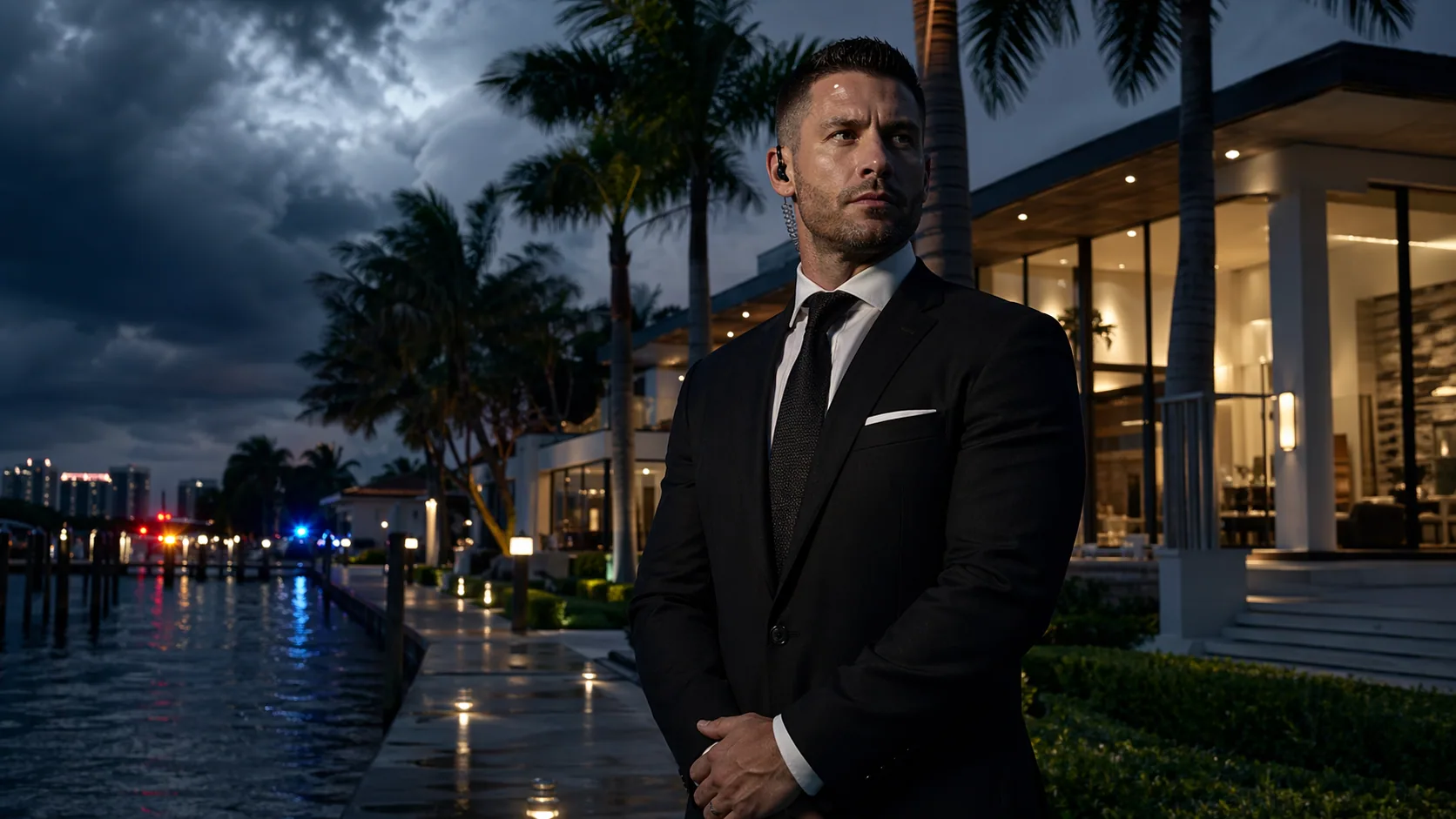
- CEOs traveling to Miami face five primary security risks: predictable transit patterns from MIA and private FBOs, digital exposure from social media and public databases, hotel and venue security gaps, the growing phenomenon of social engineering targeting executives at events, and the lack of secure ground transportation.
- Each risk is addressable with proper advance planning.
Table of Contents
Miami is one of the most active executive travel markets in the country. Brickell's finance corridor, South Beach's event venues, and Coral Gables' residential enclaves drive constant activity. The steady flow of international capital keeps high-net-worth individuals visible year-round.
That visibility creates risk. Not hypothetical risk. Practical, addressable risk that most corporate security programs either underestimate or ignore entirely for domestic travel.
What Are the Primary Airport and FBO Transit Risks for Executives in Miami?
The first vulnerability begins at arrival. Whether your executive flies commercial into Miami International Airport (MIA) or arrives via private aviation at Signature Aviation, Atlantic Aviation, or Opa-locka Executive Airport, the transit between the aircraft and the vehicle is a window of exposure.
At MIA, executive arrivals are funneled through predictable terminal exits. Curbside pickup areas are crowded, poorly controlled, and visible from multiple angles. Ride-share staging areas create bottlenecks. Anyone who knows which flight the executive is on (and flight data is publicly available for commercial flights) can position themselves at the right exit at the right time.
At private FBOs, the risk is different but real. FBO lobbies are semi-public. Line staff handle luggage and interact with arriving passengers. Vehicle staging at FBOs is often adjacent to the lobby entrance with minimal separation between the executive and the public access road.
The solution is a secure arrival sequence: advance coordination with the FBO, pre-staged vehicle, protection team in position before the aircraft lands, and a controlled walk from aircraft to vehicle. For commercial arrivals, a meet-and-greet protocol inside the terminal with vehicle staged at a pre-cleared position.
How Does Digital Exposure Create Risks Before and During Miami Travel?
Your executive's Miami trip may already be public before they board the plane.
Corporate event registrations, conference speaker lists, social media posts, and even flight-tracking websites (for private aviation) can reveal travel plans. "CEO Database" websites aggregate executive schedules from public filings and event registrations. Real-time location data from apps, check-ins, and tagged social media posts compounds the problem once the executive arrives.
In Miami specifically, the social culture amplifies digital exposure. Restaurants, clubs, and events in Brickell, Wynwood, and South Beach are heavily photographed and posted in real time. An executive photographed at a dinner in Brickell at 9 PM has had their location broadcast to anyone watching.
Address this before the trip. Scrub upcoming travel references from public calendars and event listings where possible. Brief the executive on social media discipline during travel. Conduct a digital footprint review to understand what information about the executive is already publicly accessible.
How Significant Are Hotel and Venue Security Gaps in Miami?
Miami's luxury hotels are world-class in hospitality. They are inconsistent in security. Lobby areas at properties in Brickell, Miami Beach, and Coconut Grove function as semi-public spaces. Anyone can walk in, sit down, and observe arrivals and departures. Front desk staff, valet teams, and concierge personnel have access to guest names and room numbers. Staff turnover in Miami's hospitality industry is high.
For executives staying multiple nights, the risks compound. Daily routines (gym at 6 AM, breakfast at the same restaurant, same elevator bank) create patterns. Room service deliveries, housekeeping schedules, and minibar restocking mean hotel staff enter the room regularly.
Mitigate this with a hotel advance: assess the property before arrival, coordinate with hotel security for room placement (away from elevators, near emergency exits, not on the ground floor), request restricted room access, and vary daily patterns. For multi-night stays, a residential rental with controlled access may be more secure than a hotel.
What Makes Social Engineering a Major Threat at Miami Events?
Miami hosts hundreds of corporate events, finance conferences, and industry gatherings annually. The Orange County Convention Center in Orlando gets the volume, but Miami gets the high-end events where deal-making happens in hotel suites, restaurant back rooms, and private club settings.
At these events, social engineering is the primary threat vector. An individual posing as a fellow attendee, a potential investor, or a conference organizer can get close to an executive, extract personal information, or create a pretext for follow-up contact. In Miami's social environment, where networking is aggressive and the line between business and entertainment blurs, executives are more likely to let their guard down.
This is a protective intelligence problem, not a physical security problem. Brief your executive on social engineering tactics before the event. Have a team member present (discreetly) who can observe interactions and intervene if someone is pushing too hard for personal details, schedule information, or follow-up meetings that feel wrong.
Core Elements of Effective Event Protection
Protective Intelligence
Pre-event research on attendees and known social engineering tactics.
Discreet Presence
Team members positioned to observe interactions without drawing attention.
Executive Briefing
Clear guidance on recognizing and deflecting information-seeking approaches.
Why Is Secure Ground Transportation Critical in Miami?
The gap between the hotel and the meeting, the restaurant and the event, the venue and the airport is where most security programs fail. Standard car services (even premium ones) provide drivers who are trained in hospitality, not security. They do not conduct counter-surveillance during movement. They do not plan alternate routes. They do not know how to respond to a vehicle-based threat.
In Miami traffic, which is unpredictable, aggressive, and often gridlocked, an unplanned vehicle stop in the wrong location can create a vulnerability that did not exist five minutes earlier.
Secure transportation means a trained protective driver, not a chauffeur. It means primary and alternate routes pre-planned between every stop on the itinerary. It means counter-surveillance awareness during movement. And it means a vehicle that has been inspected before the executive enters it.
For executives using private aviation, coordinate secure transportation between the FBO (Signature Aviation at MIA, Atlantic Aviation at FLL, or Opa-locka Executive) and the first destination. This is the most neglected transit segment in most corporate travel security plans.
How Can Corporate Security Teams Address These Miami Travel Risks?
Every one of these risks is addressable. None of them require an armored motorcade or a ten-person detail. What they require is advance planning: threat assessment before the trip, route and venue planning, digital exposure mitigation, and trained operators who understand how Miami's specific environment creates and amplifies risk.
That is what executive protection is. Not the visible presence. The invisible preparation that makes the visible part unnecessary.
- Advance coordination with FBOs and hotels eliminates predictable patterns.
- Digital footprint reviews conducted before travel limit public exposure.
- Trained protective drivers and pre-planned routes address the most common failure point.
- Protective intelligence provides context for both physical and social risks.
Related Protection Resources
Executive Protection Services
Learn how comprehensive executive protection integrates all five risk areas discussed.
Protective Intelligence
Understand how pre-travel intelligence identifies social engineering and digital risks.
Travel Security Services
Explore full travel security planning for high-visibility destinations like Miami.
Planning executive travel to Miami?
Contact UsFrequently Asked Questions
Miami is not inherently dangerous, but it is a high-visibility environment for executives and high-net-worth individuals. The combination of wealth concentration, international traffic, and extensive media and social coverage creates an elevated risk profile compared to lower-profile cities. The risks are manageable with proper planning.
Any executive with a public profile, known net worth, or active threat history should use executive protection for Miami travel. The city's social visibility, airport logistics, and high-profile venue culture make it an environment where unprotected executives are exposed to avoidable risks.
The biggest risk is predictability. Executives who stay at the same hotels repeatedly create patterns that can be studied. Hotel staff turnover means new employees have access to room information. And luxury hotel lobbies in Brickell and Miami Beach are functionally public spaces where anyone can observe arrivals and departures.
Praetorian provides advance work including route planning, hotel and venue assessment, secure transportation from MIA or private FBOs like Signature Aviation and Atlantic Aviation, close protection during the visit, and digital exposure mitigation. The protection plan is built around the specific itinerary and threat profile.
Digital exposure often reveals travel plans before departure through event registrations, social media, and public databases. In Miami the social culture of real-time posting from Brickell, Wynwood, and South Beach further increases visibility. A pre-travel digital footprint review limits this exposure.
Advance planning addresses all five primary risks. It includes protective intelligence, route and venue assessments, secure transportation coordination, and digital mitigation. Christopher Smith's experience protecting high-profile executives shows that preparation makes visible security measures unnecessary.
Standard car services lack counter-surveillance, alternate route planning, and threat response training. Miami traffic creates frequent unplanned stops. Trained protective drivers who conduct pre-movement vehicle inspections and maintain situational awareness close this critical gap.