 18 min read
Moving to Florida from New York in 2026: High-Net-Worth Guide from a Florida Security Insider
If you are moving to Florida from New York in 2026, here is the wealth-move checklist HNW families consistently miss. Beyond the obvious tax savings, relocating from a controlled Manhattan environment to an open Florida estate creates financial, legal, and personal exposure that most families only discover after closing.
Updated June 20, 2026 · 18 min read
- If you're moving to Florida from New York in 2026, HNW families often overlook domicile rules, public records exposure, and the shift from doorman buildings to open estates.
- This guide covers tax savings, residency establishment, neighborhood choices, and when to integrate security planning.
Table of Contents
If you are moving to Florida from New York in 2026, here is the wealth-move checklist HNW families consistently miss. Beyond the obvious tax savings, relocating from a controlled Manhattan environment to an open Florida estate creates financial, legal, and personal exposure that most families only discover after closing. This guide covers the tax logic, the domicile mechanics, the neighborhood decision, and the security blind spots that separate a clean Florida relocation from a costly one.
Why are wealthy New Yorkers moving to Florida in 2026?
The New York to Florida corridor is the largest interstate wealth migration route in the country. Over 91,000 New Yorkers relocated to Florida in 2022, and 72,424 followed in 2023. IRS migration data for tax year 2022 show New York lost roughly $9.9 billion in adjusted gross income to outmigration, while Florida received a net AGI inflow of $20.6 billion.
The tax logic is straightforward.
Florida has no state income tax. New York's top marginal rate reaches 10.90% for income above $25 million, with NYC adding up to 3.876% on top. High earners save between $15,000 and $30,000 annually even at moderate income levels. A household earning $250,000 saves approximately $22,000 per year. At $1M in annual income, the savings exceed $100,000, compounding to well over $1M in a decade.
Florida imposes no estate tax, unlike New York, where estate tax rates reach up to 16% with a punishing cliff rule at roughly $7.35M.
Retirees in Florida save $6,000 to $8,000 annually on retirement income taxes. No tax on Social Security, pensions, or IRA distributions at the state level.
Non-tax drivers matter too. Miami has become a major tech hub attracting venture capital. Miami offers world class museums, cultural diversity, and a financial infrastructure that now rivals New York's depth. The sunshine state delivers year-round access to Atlantic and Gulf coasts, and South Florida locales like Miami Beach, Boca Raton, Coral Gables, and Fort Lauderdale match NYC lifestyle expectations for dining, schools, and urban amenities.
A quieter pattern is emerging. Some HNW families are choosing Brevard County (Cocoa, Melbourne, Viera) for lower-profile waterfront estates near Orlando and the Space Coast.

What tax and estate planning rules change when you leave New York for Florida?
New York state taxes the worldwide income of its domiciliaries and statutory residents. Florida taxes neither. This single difference reshapes income planning, estate planning documents, and the timing of major liquidity events.
Domicile versus statutory resident. If you claim Florida domicile but maintain a permanent place of abode in New York and spend more than 183 days there, New York can still tax you as a statutory resident on all taxable income. For the first two years after a move, you must think about both classifications.
Estate tax contrast. New York's estate tax kicks in on estates exceeding approximately $7,350,000 in 2026. If the estate exceeds that threshold by more than 5%, the entire estate is taxable, not just the overage. Rates run from 3.06% to 16%. Florida has no state estate tax at all.
Key coordination points with your advisors include Florida asset-protection trusts and homestead creditor protections that require Florida-specific counsel. If one spouse maintains a New York home, that spouse's domicile status may remain ambiguous. Joint versus separate domicile strategies need careful structuring. Any property kept in Manhattan, the Hamptons, or Long Island may still attract New York nonresident estate tax. Plan significant capital gains, option exercises, or business sales after Florida domicile is clearly established and documented.
This article draws from patterns observed among Christopher Smith's clients relocating to the Space Coast. It is not tax or legal advice. Rely on your own CPAs and attorneys for formal guidance on domicile, estate planning, and residency.
How do you legally establish Florida domicile and cut New York residency ties?
Establishing Florida residency is proven through behavior and paperwork, and New York auditors from the New York State Department of Taxation and Finance look for inconsistencies in both.
The 183-day rule works like this. Spending more than 183 days in New York in a tax year, combined with maintaining a permanent place of abode there, can make you a statutory resident. But for high-net-worth individuals under audit, 183 days is a floor, not a safe harbor. New York tracks millionaire address changes closely, with roughly 1,679 returns reporting AGI of $1M+ changing addresses out of state in 2024.
Florida requires the following concrete steps. Obtain a Florida driver's license within 30 days of moving. Register your vehicle in Florida within 30 days of residency. Register to vote at your Florida address and cancel your New York voter registration. File a Declaration of Domicile with the county clerk. Update your address change for IRS filings, banks, brokerage accounts, and professional licenses. File tax returns using your Florida address.
The home test. Your Florida residence should match or exceed your New York property in size, value, and household function. Move artwork, family heirlooms, and daily-use items. If your family lives in Florida, that strengthens the claim. If your spouse stays in New York, risk multiplies.
Severing New York ties. Convert your Manhattan or Long Island property to secondary status or full rental. Move club memberships, doctors, and schools. End routine patterns that suggest New York is still home.
Day-counting protocol. Maintain calendars backed by credit card statements, airline tickets, and phone location logs. This evidence must withstand an aggressive New York residency audit for the first 2-3 tax years. Think of it as a compliance project, not a lifestyle change.
Which Florida neighborhoods actually work for former New Yorkers?
Affluent New Yorkers cluster in specific Florida neighborhoods where schools, services, and cultural institutions feel familiar. Florida's job market grew 15% over the past five years, and that growth is concentrated in the metros HNW families target.
South Florida urban options include Miami Beach and Brickell for high-rise living, walkable nightlife, and median luxury home prices exceeding $650,000. Coral Gables and Coconut Grove offer tree-lined streets, family neighborhoods, and top private schools with premium pricing in gated enclaves. Fort Lauderdale provides yacht-friendly canals and easier airport access.
Palm Beach County offers Palm Beach for ultra-prime estates and legacy wealth, West Palm Beach for walkable urbanism and a growing finance corridor, and Boca Raton for gated communities, country clubs, and top-tier schools.
The Gulf Coast. Naples and Sarasota offer quieter, resort-style living, especially for retirees prioritizing golf and boating.
Space Coast (the lower-profile alternative). Families pick Cocoa Beach, Melbourne, and Indialantic for oceanfront property, strong STEM influence from Kennedy Space Center, proximity to Winter Park and Orlando International Airport, and median prices well below most Florida markets. Tampa's median home price is around $425,000. Orlando and Jacksonville offer some of Florida's most affordable housing.

Tampa's economy has diversified into financial services and cybersecurity. Florida's healthcare sector continues to expand significantly. A majority of Florida neighborhoods are governed by Homeowner Associations, which is worth understanding before you buy.
Florida has a distinct hot climate with high humidity. Daily summer temperatures sit in the low 90s, with summer humidity averaging 75-85%. Air conditioning runs year-round. The lifestyle is generally slower-paced than New York's, and the culture shock from city density to suburban sprawl is real. Traffic congestion in Miami and Tampa rivals anything on the FDR. Florida's public transit is limited, requiring car ownership for most residents.
Christopher Smith has lived and worked in Brevard County for years. He can speak to commute times along the Space Coast, which neighborhoods offer genuine privacy, and which ones put you 45 minutes from Orlando with waterfront access. For more on the area, see Brevard County protection.
What should your complete relocation budget from New York to Florida include?
A complete relocation budget from New York to Florida is a one-time operational project. For high earners, the costs are typically offset in one to two tax savings cycles.
Baseline moving costs for a standard move range from $2,000 to $7,000 for long-distance basic service, $3,000 to $7,500 for full-service companies, and $12,000 to $22,000 total for a 2-3 bedroom home. Moving during peak season (May through September) increases costs by 20-30%. Use reputable movers with experience in professional packing, climate-controlled art and wine transport, and interstate logistics.
For HNW relocations with 4+ bedrooms, white-glove service, auto transport for multiple vehicles, private aviation, and temporary housing, budget $15,000 to $40,000+. Premium pricing applies for specialty items.
Hidden first-year costs include homeowners insurance in Florida that runs higher than the national average due to hurricane risks. Flood insurance is often mandatory in coastal zones. Combined property insurance premiums can run $8,000 to $25,000+ for waterfront estates. Property taxes in Florida are reassessed upon purchase, which can reset values significantly upward from the prior owner's capped assessment. Home automation, landscaping, pool maintenance, and generator installation add up quickly. Florida's Homestead Exemption can reduce property taxes by up to $50,000 in assessed value, partially offsetting these costs.
Build a 10-15% contingency for late-stage contractor work, overlapping carrying costs between your New York home and Florida, and last-minute adjustments. Coordinate this budget with your wealth advisor and family office. Security planning folds into the same project plan.
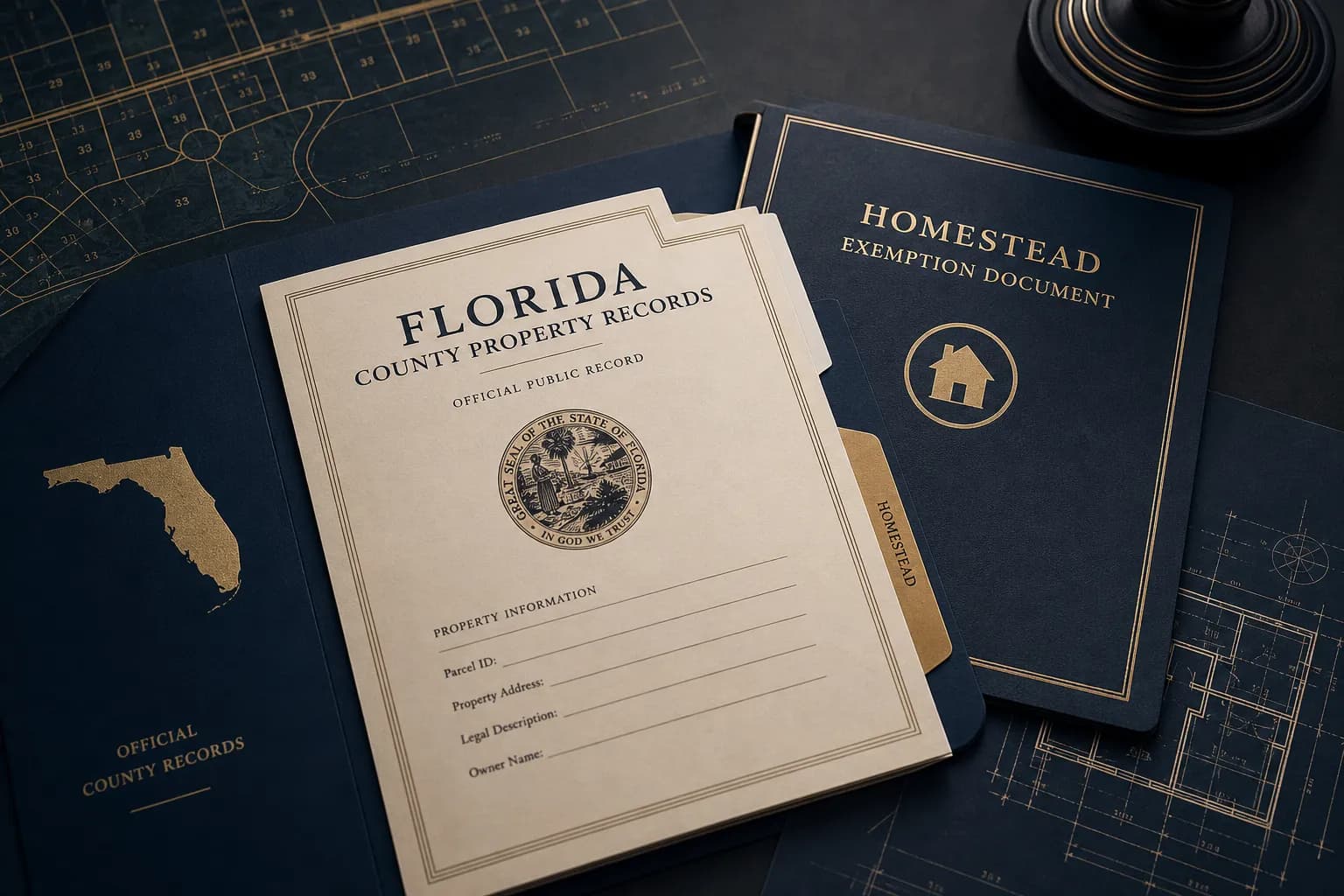
What is different about Florida property records and public visibility?
Florida is an open-records state. Property ownership here is far more searchable than wealthy New Yorkers are accustomed to.
County property appraiser and clerk of court websites in places like Miami-Dade, Palm Beach, and Brevard list owner names, situs addresses, legal descriptions, and assessed values. This information is typically indexed within 30-90 days of closing. Data brokers and people-finder services scrape these records constantly.
Homestead exemption filings, which are critical for property tax relief and creditor protection, create another layer of public data. When you file for homestead, your name and Florida address are permanently linked in county records.
The risk shift is stark. A former Manhattan co-op owner whose name was buried in corporate filings and difficult-to-search records now appears, by name, tied to a specific single-family address or waterfront estate. Anyone with a browser can find it.
Mitigation tools exist but require planning. Holding structures (LLCs, trusts) agreed with counsel, structured to comply with Florida homestead law. Careful address strategies for deliveries and mail. Opting out of commercial people-finder sites where possible.
Christopher Smith and his team typically start with an OSINT and digital exposure review and a public-records and doxxing defense assessment before a client lists or closes on a Florida property. This step costs a fraction of the exposure it prevents.
How should you think about security when trading a New York building for a Florida estate?
A Manhattan doorman building provides built-in screening: package handling, visitor logs, elevator access control, and 24/7 staffing. A single-family home in Miami Beach, Boca Raton, or along the Space Coast provides none of that by default.
Everyday differences new arrivals notice include no front-desk screening of visitors, deliveries, or contractors. Amazon, Instacart, and food delivery drivers at your gate daily. Children spending more time outdoors, on the water, and in open yards. Greater reliance on housekeepers, nannies, landscapers, and pool technicians with recurring access.
Security belongs on the same punch list as utilities, smart-home AV, and interior design. Entry control, exterior lighting, cameras, and alarm integration should be completed before or during move-in week, not six months later.
A residential security assessment for new Florida arrivals, similar to what Praetorian Executive Protection provides through residential security for new Florida arrivals, typically covers perimeter evaluation, access control, camera placement, alarm system integration, and household staff protocols.
Common oversights Christopher Smith has observed include unchanged builder-grade locks and garage door codes left at factory default. Unsecured side gates and pool enclosure entries. Exposed daily routines on social media (school drop-off times, gym schedules). Predictable nanny or housekeeper arrival patterns visible from the street.
Discreet measures make the difference: low-visibility perimeter cameras, panic hardware in primary bedrooms, and secure ground transport planning for regular trips between Florida and New York.
Related Protection Services
When is the right moment in your relocation timeline to layer in security?
Plan security in parallel with real estate, not years after closing. This is especially true when you are moving visible wealth from a high-control city to an exposed coastal property.
Decision stage. Have early risk conversations with advisors. Run a quiet review of online exposure for your family's name in both New York and Florida contexts. Check what a simple Google search reveals.
Contract stage. Once under contract, conduct a preliminary site review via satellite and street-level imagery. Check local crime patterns. Begin planning physical upgrades in coordination with contractors.
Pre-closing. Finalize security hardware specifications. Confirm that cameras, gate motors, and alarm panels can be installed during any renovation window. Review vendor and contractor access protocols.
Move-in week. On-site walkthrough with security in mind. Change all codes and locks. Commission alarm systems. Brief household staff on visitor protocols and delivery screening.
First 90 days. Refine routines. Establish secure school drop-off patterns. Maintain a low-key local presence. Where appropriate, engage close protection details for specific events or regular travel back to New York.
What does a 30 / 90 / 12-month post-move security checklist look like?
High-net-worth families benefit from treating the first year in Florida as a structured security rollout, not a one-time alarm install.
30 days. Finalize perimeter gate and lock settings. Test alarm systems under live conditions (triggered, verified, responded to). Confirm local emergency response times for your specific address. Audit all address change records to ensure no unnecessary personal details leaked.
90 days. Review vendor and contractor access logs. Refine smart-home permissions (who has codes, app access, remote unlock). Stock hurricane supplies before the next June 1 season start (hurricane season runs from June to November). Confirm family comfort with emergency plans, evacuation routes, and communication protocols.
12 months. Walk the property perimeter at night. What's visible? What's audible? Reassess based on neighborhood changes, construction, or new neighbors. Update security posture in light of any media exposure or corporate role changes. Calibrate protection ahead of the next tax year and travel cycle.
After years protecting Jeff Bezos and Amazon board members at Kennedy Space Center, then building my own practice in Cocoa, the pattern I see is consistent: newly relocated families from New York get the tax move right, get the real estate right, and completely overlook the exposure shift. Public records, open perimeters, and predictable routines are the three things I brief every new client on within the first 90 days.
Christopher SmithFounder, Praetorian Executive Protection
Explore Praetorian protection programs and the HNW security program for examples of how staging and budgeting security over time works in practice.
How does Florida compare to other no-income-tax states for high-net-worth relocations?
For New Yorkers leaving the Northeast, Florida usually beats Texas, Tennessee, and Nevada on flight time, weather comfort, waterfront inventory, and established peer networks.
Florida offers no state income tax, 2.5-3 hour flights to NYC, extensive waterfront estates on both coasts, hurricane weather risk, deep HNW peer ecosystems in Palm Beach and Miami, and residential security norms centered on gated communities and professional services.
Texas offers a similar tax profile but different weather risks and longer flights back to New York. Tennessee lacks coastal options and the Wall Street ecosystem. Nevada works for West Coast relocations but is geographically awkward for executives who commute to Manhattan several times a month.
Florida's combination of zero state income tax, no state estate tax, direct flight connectivity with New York, and established HNW ecosystems in Palm Beach, Miami, and the Space Coast is difficult to match. New York's depth of cultural institutions and urban amenities is increasingly replicated in South Florida, which is not yet true of most competing states.
How does Christopher Smith's Florida experience shape this guidance?
My path ran from the United States Marine Corps to the Lynchburg Police Department in Virginia, then to the Titusville Police Department here on the Space Coast, and later to leading personal security for Jeff Bezos and the Amazon Board of Directors at Kennedy Space Center. I have lived and worked in Cocoa and wider Brevard County through all of it.
I watch New York and California executives buy in Indian Harbour Beach, Melbourne, and Viera every year. The ones who plan well land smoothly. The ones who treat Florida like a long vacation eventually call someone like me after a problem surfaces, not before.
Designing low-visibility protection around launch windows, VIP visits, and high-profile events at KSC taught me that the same methodical, layered approach applies to private residences and family routines. There is no substitute for walking the property, understanding the neighborhood rhythm, and building systems that work without drawing attention.
What I see wealthy new arrivals routinely miss in the first 90 days: public records footprints they never had in New York, hurricane season timing they underestimate, and the assumption that a gate and a Ring doorbell equal security.
For readers exploring specific areas, see our Miami protection or Melbourne and Indialantic coverage pages.
- The tax win is real, but it is only the first move. Florida domicile must be proven through behavior and paperwork, not just an address change.
- Florida is an open-records state. Your name and home address become publicly searchable within 30 to 90 days of closing.
- A doorman building's built-in screening disappears the day you move to a single-family estate. That gap has to be designed for, not assumed.
- Security belongs on the move-in punch list alongside utilities, AV, and interior design, not six months later.
- Public records exposure, open perimeters, and predictable routines are the three risks new arrivals consistently underestimate.
- Hurricane season runs June to November. Coastal buyers should have a written plan and a hardening budget before June 1.
What should you do next if you are planning a New York to Florida move?
Align your tax, real estate, and security planning on a single timeline for 2026. Handling them in silos creates gaps that cost money and create exposure.
Immediate steps. Build a written relocation plan with target dates for domicile filing, property closing, and family transition. Engage your tax and estate planning team early, especially for New York to Florida migration coordination. Shortlist Florida neighborhoods that match your family's needs across schools, commute, and lifestyle. Sketch a complete relocation budget including moving companies, first-year insurance, and property tax reassessment.
Parallel security track. Schedule a residential security assessment once under contract. Perform an OSINT and digital exposure review before closing. Plan hurricane and evacuation protocols ahead of your first season.
If you are purchasing in Brevard County, Miami, or along the Melbourne coast, explore residential security for new Florida arrivals and hurricane protection to understand what structured coverage looks like for luxury coastal homes.
Ready for a practitioner's perspective on your specific move? Schedule a confidential consultation for a 20-minute Executive Risk Snapshot with Christopher Smith.
Explore More Resources
Frequently Asked Questions
The 183-day rule is a New York state statutory residency test, not a complete domicile standard. You must be physically present in Florida for at least 183 days, but domicile also requires demonstrating intent through home size, family location, schools, voter registration, and daily life. High-net-worth movers should plan to spend well over half the year in Florida while building deep ties.
Yes. In counties like Miami-Dade, Palm Beach, and Brevard, property ownership, sale price, assessed value, and legal descriptions are searchable online. This data is often scraped by third-party sites within 30-90 days of closing. Most families manage privacy through holding structures and digital-threat mitigation.
Occupy the property as your primary residence as of January 1. File with the county property appraiser by the March 1 deadline. Provide proof of Florida residency including a valid driver's license, voter registration, and vehicle registration. The exemption can reduce property taxes by up to $50,000 in assessed value and provides creditor protection.
Commission an assessment as soon as you are under contract or immediately after closing so locks, gates, cameras, and alarm systems are in place before your family occupies the home. Many clients schedule this in parallel with interior design and AV installation as part of the standard move-in punch list.
Coordinate move dates and deliveries to avoid long gaps when your Florida home sits furnished but unoccupied. Do not publish real-time details on social media. High-net-worth families often use vetted movers with interstate experience, secure transportation during the move, and brief on-site protection until routines and neighborhood patterns are understood.
Hurricane season runs from June to November. Anyone closing on a coastal property should budget for hardening measures and have a written hurricane plan before June 1. This includes impact shutters or rated windows, a whole-home generator, and documented family evacuation routes.
Ready for a practitioner's perspective on your specific move?
Book a 20-minute Executive Risk Snapshot with Christopher Smith.
Schedule a confidential consultationWritten by Christopher Smith
Founder, Praetorian Executive Protection LLC